Blogs
How to Optimize Trading Decisions for Quantitative Edge
Nick Garidzhuk
Refining the way you approach quantitative trading often starts with identifying inefficiencies in your existing workflows. As ambitious traders in markets from New York to Singapore push for higher precision, the integration of advanced algorithmic approaches and conversational AI is transforming decision-making. This overview highlights practical steps for assessing, upgrading, and validating your proprietary trading processes, ensuring your strategies remain adaptive and insightful amid evolving market conditions.
Table of Contents
Quick Summary
Key Point | Explanation |
|---|---|
1. Assess Current Workflows | Document and evaluate each component of your trading process to identify inefficiencies and potential optimizations. |
2. Integrate Conversational Insights | Use AI tools to convert complex financial data into actionable insights that enhance decision-making. |
3. Apply Advanced Data-Driven Strategies | Implement multi-indicator approaches and machine learning to improve trading signals and execution. |
4. Validate Decisions with Feedback | Use advanced platform feedback mechanisms to refine strategies and ensure ongoing reliability through performance metrics. |
5. Monitor Outcomes and Refine Approach | Continuously track performance metrics and adapt your strategy for consistent improvement and relevance in changing markets. |
Step 1: Assess current trading workflows
Improving your quantitative trading strategy begins with a systematic evaluation of your existing workflows. This crucial first step helps identify inefficiencies, technological gaps, and opportunities for optimization.
To effectively assess your current trading workflows, start by documenting each component of your trading process. This includes data collection methods, signal generation techniques, risk management protocols, and execution strategies. Modern trading technologies have significantly transformed these workflows, with advanced algorithmic approaches enabling more sophisticated decision-making.
Key areas to analyze in your workflow assessment include:
Data Sources: Evaluate the quality and comprehensiveness of your current market data inputs
Signal Generation: Review the algorithms and models used for trade signal identification
Execution Mechanisms: Analyze your current order placement and trade execution methods
Risk Management: Examine your existing risk assessment and mitigation strategies
Pay special attention to potential points of technological integration. Many trading firms are now adopting hybrid technologies that combine traditional statistical methods with machine learning techniques. This approach can provide more nuanced insights and improve overall trading performance.
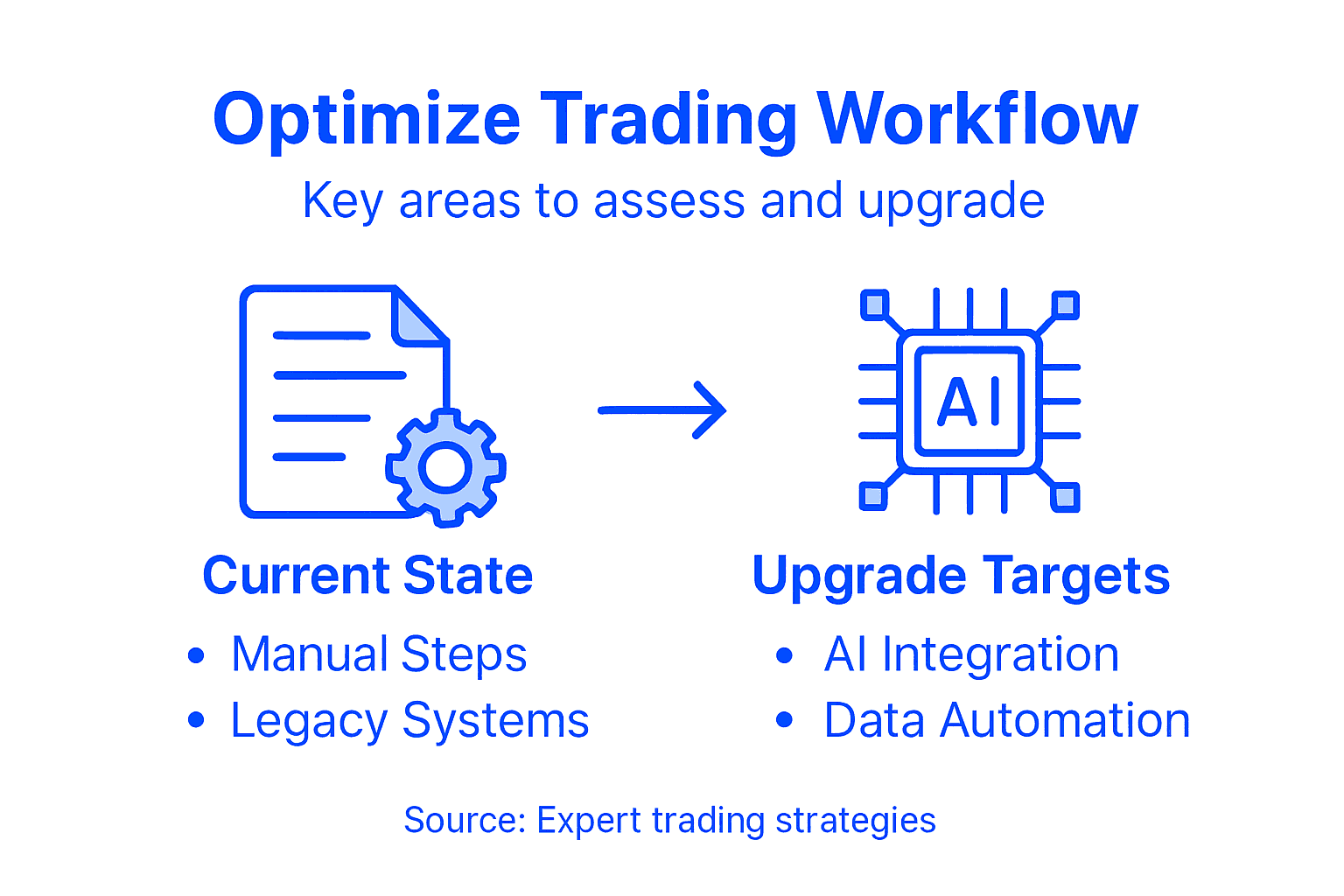
Here’s a quick comparison of traditional versus modern quantitative trading workflows:
Workflow Aspect | Traditional Approach | Modern/AI-Driven Approach |
|---|---|---|
Data Collection | Manual, limited sources | Automated, diverse data streams |
Signal Generation | Statistical models | Machine learning algorithms |
Risk Management | Rule-based protocols | Dynamic AI-driven techniques |
Execution Mechanisms | Manual order entry | Real-time algorithmic execution |
This reference can help identify where technology upgrades may have the greatest impact on trading efficiency.
Pro tip: Create a detailed workflow diagram that visually maps out each step of your current trading process, helping you spot hidden inefficiencies and potential optimization opportunities.
Step 2: Integrate conversational insights into analysis
Transforming your quantitative trading approach requires seamlessly integrating conversational insights that go beyond traditional data analysis. This step focuses on leveraging advanced AI technologies to enhance your trading decision-making process.
Modern quantitative traders can now utilize conversational AI tools that transform complex financial data into actionable insights. These intelligent systems enable traders to extract nuanced information through natural language queries, bridging the gap between raw data and strategic understanding.
Key strategies for integrating conversational insights include:
Natural Language Processing: Implement AI tools that can interpret complex trading language
Real-Time Data Interpretation: Use systems that translate market signals into comprehensible narratives
Interactive Query Mechanisms: Develop platforms allowing direct, conversational interactions with trading data
Context-Aware Analysis: Select AI tools that understand industry-specific financial contexts
Successful integration requires selecting AI technologies that complement your existing analytical frameworks. Look for tools that provide professional-grade insights while maintaining objectivity and precision in their interpretations.
Pro tip: Regularly validate your conversational AI insights against traditional quantitative metrics to ensure reliability and maintain a balanced analytical approach.
Step 3: Apply advanced data-driven strategies
Transforming your trading approach requires implementing sophisticated data-driven strategies that leverage cutting-edge analytical techniques. This step focuses on integrating multi-indicator approaches and artificial intelligence to enhance your trading performance.
Quantitative traders can now utilize advanced algorithmic techniques that systematically process complex market data to generate more precise trading signals. These strategies go beyond traditional analysis by combining multiple data sources and sophisticated computational methods.
Key components of advanced data-driven strategies include:
Multi-Indicator Analysis: Develop trading signals by integrating diverse technical indicators
Machine Learning Models: Implement AI-driven predictive algorithms for market forecasting
Real-Time Data Processing: Create systems that can rapidly analyze and respond to market changes
Risk Management Algorithms: Design sophisticated models that dynamically assess and mitigate potential trading risks
Successful implementation requires a comprehensive approach that balances technological sophistication with robust risk management. The goal is to create a dynamic trading system that can adapt to changing market conditions while maintaining consistent performance.
Advanced data-driven strategies transform raw market information into actionable trading insights, reducing human bias and increasing analytical precision.
Pro tip: Continuously backtest and validate your data-driven strategies using historical market data to ensure their reliability and effectiveness before live implementation.
Step 4: Validate decisions with platform feedback
Ensuring the reliability of your trading strategies requires a systematic approach to decision validation through advanced platform feedback mechanisms. This step focuses on leveraging sophisticated evaluation techniques that transform raw trading actions into refined, high-performance strategies.
Modern quantitative traders can implement reinforcement learning models that dynamically incorporate expert feedback and technical indicators to validate and improve trading decisions. These advanced systems provide real-time insights that help traders continuously refine their approach across different market environments.
Key validation strategies include:
Performance Metrics Tracking: Monitor comprehensive performance indicators beyond simple profit/loss
Simulated Environment Testing: Use platform-based simulations to validate strategy robustness
Technical Indicator Cross-Referencing: Compare trading decisions against multiple technical signals
Adaptive Learning Mechanisms: Implement systems that automatically adjust strategies based on platform feedback
Successful validation requires a holistic approach that goes beyond surface-level metrics. Your goal is to create a self-improving trading system that can continuously adapt and optimize its performance.
Platform feedback is not just about tracking performance - it’s about transforming raw data into actionable strategic insights.
Pro tip: Develop a standardized feedback review process that systematically evaluates your trading decisions, focusing on both quantitative results and the underlying decision-making logic.
Step 5: Monitor outcomes and refine approach
Successful quantitative trading requires continuous performance evaluation and strategic adaptation. This step focuses on developing a systematic method for tracking trading results and implementing data-driven refinements to your investment approach.
Modern traders can leverage adaptive quantitative strategies that dynamically adjust to changing market conditions. These advanced frameworks enable real-time monitoring and iterative optimization of trading performance across diverse market environments.
Key outcome monitoring strategies include:
Comprehensive Performance Analysis: Track detailed metrics beyond simple profit and loss
Comparative Benchmarking: Compare strategy performance against relevant market indices
Risk-Adjusted Return Evaluation: Assess performance using metrics like Sharpe ratio
Periodic Strategy Reassessment: Schedule regular reviews of trading approach effectiveness
Successful refinement requires a proactive and data-driven approach to strategy management. Your goal is to create a continuously learning trading system that adapts quickly to market dynamics.
Below is a summary table highlighting critical outcome metrics for ongoing strategy refinement:
Metric Type | Purpose | Example Metric |
|---|---|---|
Performance Analysis | Measure profitability trends | Monthly ROI |
Benchmarking | Compare with market standards | S&P 500 returns |
Risk-Adjusted Evaluation | Assess the risk vs reward ratio | Sharpe ratio |
Strategy Reassessment | Ensure ongoing relevance | Quarterly review |
Regular tracking of these metrics supports continuous improvement in trading outcomes.
Effective outcome monitoring transforms raw trading data into strategic insights that drive consistent improvement.
Pro tip: Implement a structured quarterly review process that systematically breaks down your trading performance, identifying both successful patterns and areas requiring strategic adjustment.
Unlock Your Quantitative Edge with Conversational AI
Optimizing trading decisions requires more than just data and algorithms. This article highlights key challenges, including assessing complex workflows, integrating conversational insights, and validating strategy performance. If you are struggling to bridge traditional quantitative models and real-time, intuitive decisions, you are not alone. Many traders face the frustration of navigating multifaceted data without a clear path to tie their intuition into proven, quantifiable edges. Concepts like multi-indicator analysis and platform feedback demand next-level technology designed for real traders.
At Nvestiq, we understand these challenges deeply. Our platform uniquely captures the nuance of a real trader’s intuition and transforms simple conversation into actionable trading advantages. Imagine leveraging advanced AI to not only interpret your data but also to dynamically adapt as markets shift. This innovative approach addresses the exact pain points discussed in the article, including enhanced signal generation, context-aware analysis, and continuous strategy refinement.
Explore how you can seamlessly integrate your workflow with cutting-edge AI insights today. Visit our main site to experience the future of trading technology. Don’t wait to gain the critical edge you deserve. Take charge of your strategic growth with Nvestiq now.
Frequently Asked Questions
How can I assess my current trading workflows to optimize them?
Start by documenting every step of your trading process, including data collection, signal generation, and risk management. Once you have a clear picture, identify inefficiencies and opportunities for improvement.
What advanced technologies should I consider for optimizing trading decisions?
Explore hybrid technologies that combine traditional statistical methods with machine learning techniques. Implementing AI-driven tools can enhance your signal generation and risk management strategies, potentially increasing performance by up to 30%.
How should I integrate conversational insights into my trading analysis?
Utilize natural language processing tools that allow for easy querying of trading data. By developing an interactive platform for understanding market signals, you can enhance decision-making and gain actionable insights in real time.
What steps can I take to validate my trading decisions?
Adopt performance metrics tracking that goes beyond simple profit and loss calculations. Systematically monitor your strategies using simulated environments and cross-referencing multiple technical indicators to continually refine your trading approach.
How often should I monitor and refine my trading outcomes?
Implement a quarterly review process to systematically evaluate your trading performance. By conducting these reviews, you can identify successful patterns and areas for improvement, ensuring your strategies remain effective against changing market conditions.