
Blogs
Trader Mindset: A 5-Step Guide to Consistency
Aman Anand
TL;DR:
Up to 90% of trading failures are related to mindset and emotional control.
Developing self-awareness, discipline, and probability thinking is key to consistent trading success.
Regular routines, journaling, and self-audits reinforce psychological resilience and process adherence.
Up to 80-90% of trading failures are mindset-related, yet most traders spend the majority of their time searching for better strategies. The hard truth is that your edge is not just in your chart setup or your indicators. It lives in how you think, react, and recover. This guide walks you through five concrete, evidence-based steps to build a trader's mindset that holds up under pressure. You'll find practical tools, structured routines, and mental models that consistently profitable traders rely on. Whether you're just starting out or working through a rough patch, these steps will give you a clear path forward.
Table of Contents
Key Takeaways
Point | Details |
|---|---|
Mindset is critical | Psychology, not strategy, determines most trading outcomes. |
Process-driven habits | Consistent routines and rule-based systems beat willpower alone. |
Probabilities, not certainties | Thinking in probabilities helps traders avoid emotional pitfalls. |
Track and adapt | Ongoing self-audits ensure continuous mindset improvement. |
Step 1: Conduct a self-awareness audit
Having seen why mindset matters, let's start with the foundation: knowing yourself as a trader. Trader mindset development begins with an honest self-awareness audit, and skipping this step is one of the most common reasons traders plateau. Without knowing your own psychological patterns, you'll keep repeating the same costly mistakes under different market conditions.
Cognitive biases are the invisible forces that distort your judgment. Understanding trading biases is the first step toward neutralizing them. Common examples include confirmation bias (only seeing data that supports your existing position), loss aversion (holding losers too long to avoid realizing a loss), and overconfidence bias (sizing up too aggressively after a winning streak).
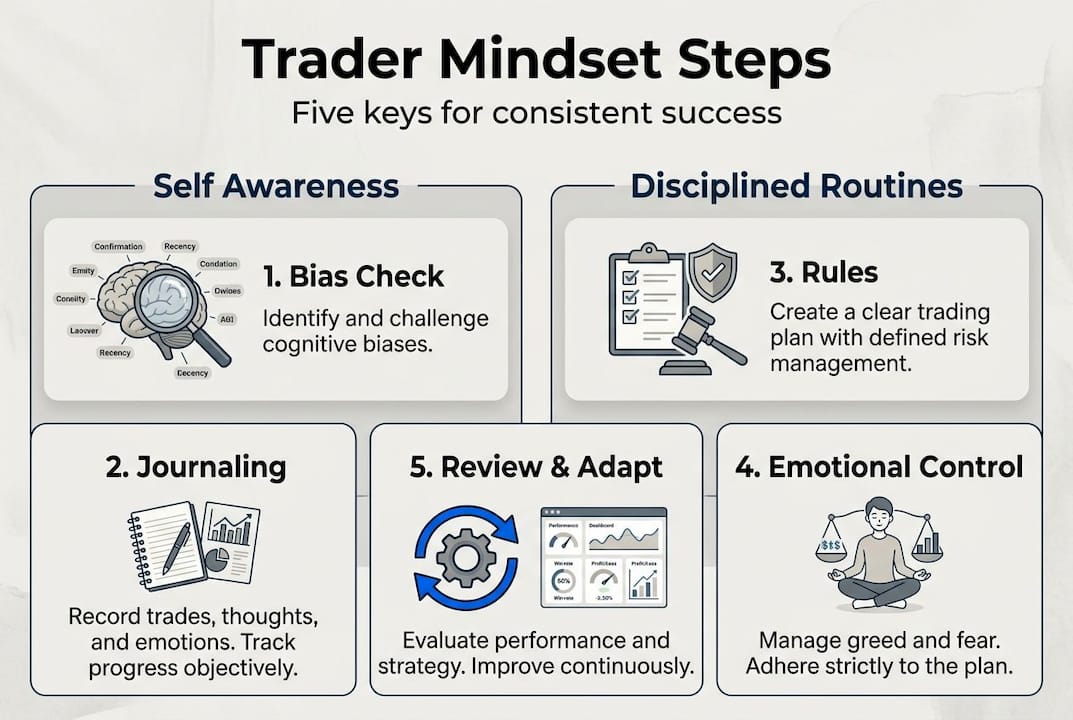
Here is a simple audit table to identify your most active biases:
Bias | Symptom | Frequency (1-5) |
|---|---|---|
Confirmation bias | Ignoring signals against your trade | |
Loss aversion | Refusing to cut losing trades | |
Overconfidence | Oversizing after wins | |
Recency bias | Changing strategy after 2-3 losses | |
FOMO | Entering trades late out of fear |
Rate yourself honestly. A score of 3 or higher in any category signals a priority area to address. Use this table weekly for the first month of your mindset work.
Quick-start checklist for identifying your biggest mindset pitfalls:
Review your last 20 trades for emotional decisions
Note which market conditions trigger impulsive behavior
Identify if you follow your rules consistently or selectively
Ask: do you trade to recover losses or to execute your plan?
Pro Tip: Journaling after every trade, win or loss, accelerates self-awareness faster than any book. Write what you felt before, during, and after the trade. Patterns emerge within weeks. Pair this with developing analysis structure to ground your emotional observations in objective data.
Step 2: Develop probability-based thinking
Once you can spot your own mental traps, it's time to rewire your thinking toward probabilities. Probabilistic thinking is essential to counter cognitive biases because it removes the emotional weight attached to individual trade outcomes. Elite traders do not think in terms of "this trade will win." They think in terms of "over 100 trades, my edge plays out."
The casino analogy is useful here. A casino does not worry about a single hand of blackjack. It knows its statistical edge and trusts the math over thousands of hands. You can operate the same way. Each trade is just one data point in a much larger sample. This reframe alone reduces anxiety and impulsive decision-making significantly.

Here is a comparison of fixed thinking versus probability-based thinking in real trade scenarios:
Scenario | Fixed thinking | Probability-based thinking |
|---|---|---|
Trade hits stop loss | "My strategy is broken." | "One loss in my expected distribution." |
Three losses in a row | "I should stop trading." | "Drawdowns are normal; check the process." |
Big win | "I've figured it out." | "One positive data point; stay consistent." |
Missed entry | "I lost money." | "Skipping bad setups protects my edge." |
Steps to build probabilistic habits:
Define your strategy's historical win rate and average risk-to-reward ratio before placing any trade
Set a minimum sample size (at least 50 trades) before evaluating your strategy's performance
After each trade, log the outcome without judgment, just data
Review results in batches of 20 to spot trends rather than reacting to individual trades
Practice moving beyond binary thinking by replacing "win or lose" language with "within or outside expected range"
This shift also supports algorithmic trading approaches, where rules govern decisions rather than emotions. When trader psychology aligns with a probability framework, profits become more consistent and sustainable.
Step 3: Build discipline through rules and routines
Adopting a probability mindset is powerful, but only structure and discipline make it stick. Willpower is a limited resource. Research consistently shows that relying on motivation alone leads to inconsistent execution, especially during losing streaks or high-volatility periods. Professional traders follow discipline and process-driven rules, not willpower, as the foundation of their consistency.
Steps to create your own trading ruleset:
Write down your entry criteria, exit criteria, and position sizing rules in plain language
Add rules for what you will NOT do (no trading in the first 15 minutes of a session, no revenge trading)
Define a maximum daily loss limit that triggers a mandatory stop for the day
Review and refine your ruleset monthly based on trade journal data
Test new rules through effective backtesting before applying them live
Sample daily routine elements used by top traders:
Pre-market review: check economic calendar, identify key levels, review overnight price action
Session prep: confirm active setups that meet your criteria only
Post-session debrief: log trades, note emotional state, review rule adherence
Weekly review: analyze performance metrics, adjust if needed
"The goal of a successful trader is to make the best trades. Money is secondary." This quote from trading educator Alexander Elder captures why optimized trading routines matter more than chasing profits directly.
Pro Tip: Use habit stacking to embed your trading routine. Attach your pre-market review to an existing habit, like your morning coffee. This reduces the mental friction of starting and makes the routine automatic within weeks. Setting trading goals that are process-focused rather than profit-focused reinforces this structure further.
Step 4: Master emotional control and resilience
Even the best systems face losing streaks, and here's how top traders bounce back. Emotional control is not about suppressing feelings. It's about recognizing them quickly and preventing them from hijacking your decision-making. 95% of day traders lose money, and a significant factor is the inability to recover psychologically after drawdowns. The traders who survive long enough to become profitable are the ones who build resilience as a deliberate skill.
Emotional control strategies that work in real-time:
Pause trigger: Before entering any trade, pause for 10 seconds and ask "does this meet my criteria exactly?" This breaks reactive patterns
Breathwork: Four counts in, four counts hold, four counts out. Use this after a loss to reset your nervous system before the next decision
Post-trade review: Immediately after closing a trade, rate your emotional state from 1 to 10. Trades placed at 8 or higher on the stress scale are worth flagging for review
Loss limit enforcement: When you hit your daily loss limit, close your platform. No exceptions. This is a non-negotiable rule, not a suggestion
Resilience journaling: Write one lesson from each losing trade. Over time, losses become data rather than emotional events
Building resilience after a losing streak requires a process-first focus. Tracking trading performance objectively helps you separate a bad day from a broken strategy. Also, professional trader rules consistently emphasize protecting capital emotionally as much as financially. And remember: 80% of profitable traders cite psychology as their primary edge, not their technical setup.
Step 5: Verify progress and avoid common pitfalls
Now that you have a complete routine, let's ensure you're improving and not sabotaging yourself. Progress in trading psychology is measurable, but only if you build feedback loops into your process. Without regular self-audits, it's easy to drift back into old habits without realizing it. The Turtle Traders experiment is a powerful example: the same system was given to multiple traders, yet results varied dramatically based on mindset and process adherence. 92% fail without a consistent process focus.
Self-audit questions to run every two weeks:
Did I follow my entry and exit rules on every trade this period?
How many trades were emotionally motivated rather than rule-based?
Did I stick to my position sizing rules, even after wins?
What was my emotional state during my worst-performing trades?
Did I complete my pre-market and post-session routines consistently?
Common pitfalls and corrective actions:
Pitfall | Corrective action |
|---|---|
Skipping the trading journal | Set a 5-minute post-trade timer as a non-negotiable |
Changing strategy after 3 losses | Require 50-trade sample before any rule change |
Overtrading in slow markets | Add a maximum daily trade count to your ruleset |
Ignoring the self-audit | Schedule it as a recurring calendar event |
Measuring only profits | Track rule adherence as a primary performance metric |
Building algorithm intuition into your review process can also help you spot behavioral patterns that pure journaling might miss. The goal is a self-correcting system that improves with every cycle. Read more about the three-phase mastery model to understand how traders progress from reactive to systematic over time.
The uncomfortable truth about trader mindset: Why skill beats willpower alone
Here is something most trading psychology content won't tell you directly: motivation is not a strategy. Traders who rely on inspiration and passion to stay disciplined will always underperform traders who have built their process into a daily system. The excitement of a new framework fades within weeks. What remains is either a structure that runs on its own or a vacuum filled by old habits.
The hidden work of mindset development is not glamorous. It's reviewing losses you'd rather forget, adjusting rules that bruise your ego, and building emotional muscle through repetition rather than insight. Most traders treat mindset as a one-time fix, reading one book or attending one webinar and expecting transformation. Real change comes from treating your psychological process the same way you treat your trading system: test it, refine it, and hold it accountable to data.
Process consistency is what separates profitable traders from the majority. Aiding intuition with AI is one way to make that process more objective and repeatable. But the foundation is always the same: show up, follow the system, and let the edge compound over time.
Take your trading further with Nvestiq's tools and guides
Ready to turn insight into action? Building a trader's mindset is a process, and having the right tools makes that process faster and more reliable. Nvestiq was built specifically to help traders codify their intuition and routines into a structured, quantifiable edge.

The Nvestiq platform bridges the gap between what you know as a trader and what you can consistently execute. From reinforcing probability-based thinking to supporting structured decision-making, Nvestiq gives you a framework that scales with your development. Explore the strategy guides to reinforce each step covered in this article and start building a trading process that holds up in any market condition.
Frequently asked questions
What is the most important trait for a winning trader's mindset?
Self-discipline and routine-building are the crucial traits repeatedly found in long-term successful traders. Discipline and process, not strategy alone, are what drive sustained results.
How do I track progress in my trading psychology?
Use a trading journal and regular self-audit questions to measure mindset improvements and adjust routines. Self-audit and reflection are core components of any serious psychology development protocol.
Why do even good strategies fail for many traders?
Without the right mindset, traders struggle with discipline, emotion, and consistency, causing even sound strategies to underperform. The Turtle experiment showed that the same system produced vastly different results based purely on the trader's mindset.
How do top traders manage their emotions?
They use structured routines and specific emotional control techniques such as reviewing trades and pause triggers. Routine emotional practices are what separate traders who survive drawdowns from those who quit.