
Blogs
Trading models: Data-driven strategies for smarter decisions
Aman Anand
TL;DR:
Algorithmic trading models use coded rules to automate decisions, outperforming emotion-driven methods.
Robust validation and realistic backtesting are crucial; most models fail in live markets due to overfitting and biases.
Sustainable edge depends on disciplined execution, ongoing monitoring, and understanding model limitations.
Most traders believe their edge comes from reading charts faster or trusting their gut more than the next person. The reality is more grounded: algorithmic trading strategies use coded rules and data to automate market decisions, consistently outperforming emotion-driven approaches over time. Trading models are not just tools for quants at hedge funds. They are structured frameworks that any serious trader can understand, evaluate, and apply. This guide walks through what trading models are, how they work mechanically, where they fail, and how you can use them responsibly to build a more consistent, data-driven edge.
Table of Contents
Advanced insights: Strategy decay, model adaptation, and sustainable edge
Applying models in the real world: From design to disciplined execution
A practical perspective: Why most traders misunderstand trading models
Key Takeaways
Point | Details |
|---|---|
Trading models overview | Algorithmic, quantitative, and machine learning frameworks can automate and improve decision-making by removing emotion from trading. |
Critical mechanics | Effective models rely on robust inputs, disciplined backtesting, and realistic performance validation—never just backtest results. |
Pitfalls and sustainability | Ninety percent of strategies fail live due to overfitting, cost underestimation, and ignoring changing market regimes. |
Edge is dynamic | Lasting trading success requires constant adaptation, attention to regime shifts, and a clear economic rationale behind each strategy. |
From theory to action | Turning models into practical tools demands discipline, detailed documentation, and commitment to never-ending learning. |
What are trading models? An essential overview
A trading model is a set of defined rules, usually expressed mathematically or in code, that tells a system when to buy, sell, or hold an asset. Rather than relying on a trader's judgment in the moment, the model processes data inputs and generates signals automatically. This removes the inconsistency that comes from emotional decision-making and allows strategies to be tested against historical data before risking real capital.
Algorithmic trading strategies fall into several major categories: momentum and trend-following, arbitrage, market-making, and machine learning-based models. Each serves a different purpose and suits different market conditions.
Model type | Automation level | Complexity | Primary use case |
|---|---|---|---|
Momentum/trend | High | Low to medium | Capturing sustained price moves |
Arbitrage | Very high | High | Exploiting price discrepancies |
Market-making | Very high | High | Providing liquidity, earning spread |
Machine learning | High | Very high | Pattern recognition across large datasets |
A common misconception is that quant models are designed to replace human intuition entirely. In practice, the best models are built to make intuition quantifiable and repeatable. They minimize emotional bias and process vast data efficiently, but they still face challenges when markets shift structurally.
Here is where each model type fits best:
Momentum models: Trending markets with clear directional bias
Arbitrage models: Liquid, correlated instruments with measurable price gaps
Market-making models: High-volume, low-volatility environments
Machine learning models: Complex, multi-variable datasets where linear rules fall short
Understanding these distinctions helps you approach intuitive algorithmic models with realistic expectations. For broader context on building your approach, reviewing algorithmic trading tips and strategy concepts can sharpen your foundation considerably.
Key model mechanics: Inputs, backtesting, and validation
Now that we have categorized the main types, let's examine what goes into these models and how their performance is rigorously tested.
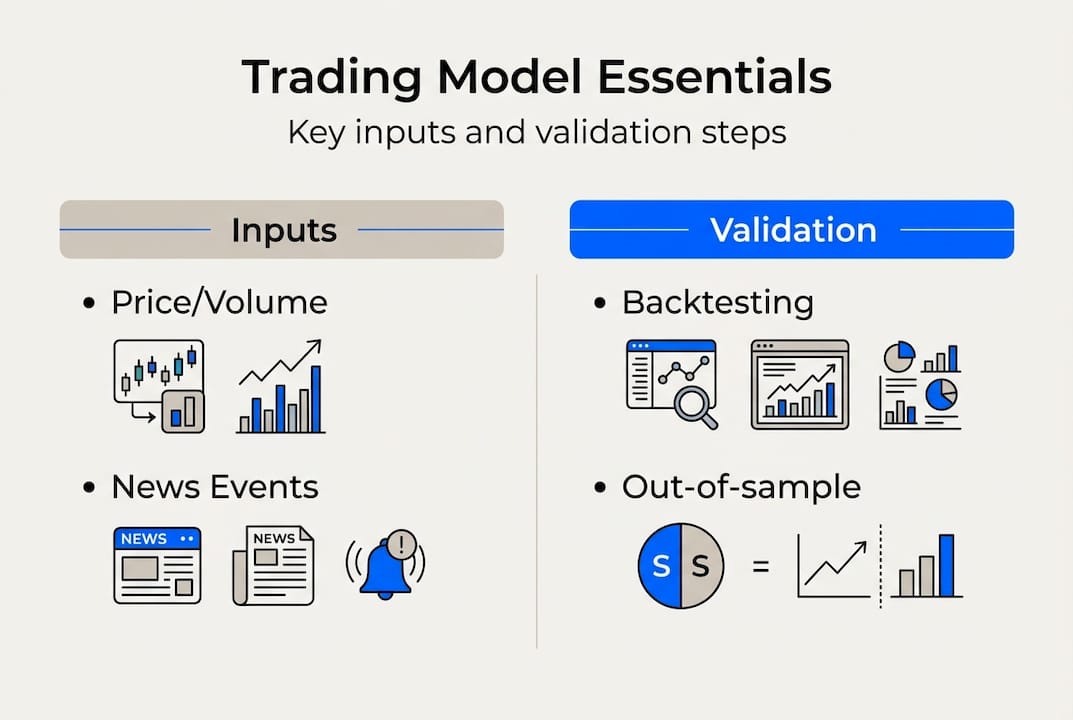
Every trading model starts with inputs. These are the raw data points the model uses to generate signals. Quantitative models are built and backtested on datasets including price, volume, technical, and fundamental indicators. Validation is crucial to ensure real-world performance.
Input category | Examples | Role in the model |
|---|---|---|
Price and volume | OHLCV data, tick data | Core signal generation |
Technical indicators | Moving averages, RSI, MACD | Trend and momentum filters |
Fundamental data | Earnings, P/E ratios, macro data | Context and regime identification |
Alternative data | Sentiment, news flow, options flow | Edge refinement |
Selecting the right technical indicators for your model is not about using more of them. It is about choosing inputs that have a logical, testable relationship with the outcome you are trying to predict.
Here is the standard model-building process:
Ideation: Define the market hypothesis and the economic rationale behind it
Coding: Translate the rules into a testable algorithm
Backtesting: Run the model against historical data with realistic costs and slippage
Out-of-sample validation: Test on data the model has never seen
Forward testing: Paper trade or run on a small live account before full deployment
Effective backtestingandportfolio backtestingare not optional steps.Structural robustnessdepends on realistic costs, out-of-sample validation, and testing across different market regimes, not just the most favorable historical period.

Pro Tip: Never accept a backtest at face value. Always check whether the developer used sample-splitting, included realistic transaction costs, and tested across multiple market regimes. A backtest that only covers a bull market is not a valid proof of concept.
Performance and pitfalls: Real results vs. model illusions
With an understanding of core mechanics, it is critical to separate genuine performance from statistical illusions.
Some models do produce measurable, repeatable results. For example, an EMA 9/21 crossover on BTCUSD yields a profit factor of 1.59 and a Sharpe ratio of 3.49, while factor momentum long-short strategies return 3.8 to 7.2% annually. These are real benchmarks worth understanding. But they are also exceptions, not the rule.
"About 90% of backtested strategies fail in live trading due to overfitting, biases, and cost misestimation."
That number is not an exaggeration. Most models that look exceptional in backtests collapse when exposed to live markets. The main failure points include:
Overfitting: The model is tuned so precisely to historical data that it cannot generalize
Survivorship bias: Testing only on assets that still exist, ignoring those that failed
Look-ahead bias: Using data in the backtest that would not have been available in real time
Unrealistic cost assumptions: Ignoring slippage, commissions, and market impact
No out-of-sample validation: The model has never been tested on data it has not already seen
High-frequency trading (HFT) is a specific case worth noting. These models improve market liquidity in normal conditions, but HFT introduces instability risks such as flash crashes, where automated selling cascades faster than any human can intervene. Reviewing momentum model results and market stability factors gives you a clearer picture of where these risks concentrate.
The takeaway is simple: be skeptical of any model that looks too good. Real edge is modest, consistent, and survives scrutiny.
Advanced insights: Strategy decay, model adaptation, and sustainable edge
To round out your trading model toolkit, gaining insight into edge sustainability and long-term risks is essential.
Even a model that works today may stop working in six months. This is called alpha decay, and it is one of the most underappreciated risks in systematic trading. Strategies regularly decay due to crowding and regime shifts. Real edge comes from economic mechanisms, not mere patterns.
Factors that accelerate strategy decay include:
Crowding: Too many traders running the same strategy, eroding the edge
Regime change: Macroeconomic or structural shifts that invalidate historical relationships
Overfitting at scale: Models that were already fragile collapse faster under real conditions
Technology shifts: Faster participants arbitrage away inefficiencies before slower models can act
Pro Tip: Search for structural advantage, not just patterns. A model built on a genuine economic rationale (such as a behavioral bias or a structural liquidity imbalance) will decay far more slowly than one built purely on curve-fitting historical price data.
Machine learning in trading models introduces its own failure mode: search bias. When you run thousands of ML experiments to find a pattern, you will find one eventually, even if it is random noise. Empirical edges persist for months, but decay, and moderate adaptation, regime filters, and incubation improve long-term viability. The solution is not to stop using machine learning but to apply rigorous three-layer validation and maintain a healthy skepticism toward any result that seems unusually strong.
Sustainable edge also requires ongoing monitoring. Markets are not static, and a model that worked in a low-volatility regime may behave very differently in a high-volatility one. Adaptation is necessary, but it must be disciplined and evidence-based rather than reactive.
Applying models in the real world: From design to disciplined execution
Armed with awareness of strengths and weaknesses, let's walk through the practical application, specifically how to responsibly use models for smarter trading.
The gap between a working backtest and a profitable live strategy is where most traders lose confidence. Closing that gap requires process, not luck. Here is a practical implementation sequence:
Define your hypothesis: What market inefficiency are you targeting, and why does it exist?
Build and code the rules: Keep the model as simple as possible at first
Backtest with realistic assumptions: Include transaction costs, slippage, and position sizing
Validate out-of-sample: Reserve at least 30% of your data for testing the model that the model has never seen
Forward test in a controlled environment: Paper trade or use minimal capital before scaling
Deploy with defined risk limits: Set maximum drawdown thresholds and position size caps
Monitor and log everything: Track every signal, execution, and deviation from expected behavior
Online portfolio strategies like CWMR and PAMR have historically outperformed benchmarks when evaluated using rigorous backtesting and disciplined execution. These results reinforce that robust validation matters more than perfect parameter tuning.
Pro Tip: Keep a detailed change log for every model modification. When a model starts underperforming, your log will tell you whether the issue is a regime shift, a coding error, or an execution problem. Without records, diagnosis is guesswork.
For traders ready to automate, learning how to approach automated trade execution responsibly is the next logical step after validation.
A practical perspective: Why most traders misunderstand trading models
Before wrapping up, it is worth confronting the biggest misconception traders have about models.
Most traders approach trading models as signal generators. They want a system that tells them when to buy and sell, and they evaluate models almost entirely on recent returns. This framing misses the actual value. The real benefit of a trading model is that it forces you to articulate your edge clearly, test it honestly, and execute it consistently without emotional interference.
The failures we see repeatedly are not technical. They are failures of discipline. Traders override their models when they feel nervous, abandon strategies after short drawdowns, and constantly tweak parameters in search of a better backtest. This behavior destroys the very consistency that makes models valuable in the first place.
The algorithmic trading guide that actually serves you is not the one with the highest backtest Sharpe ratio. It is the one you can execute with conviction through a losing streak, because you understand why it should work and have validated it properly. Disciplined adaptation, not endless tweaking, is what separates successful model traders from the rest.
Take your trading model mastery further
Ready to move from theory to confident, data-driven trading? Understanding trading models is only the first step. Putting them into practice requires the right tools, structured testing environments, and a platform that can translate your trading intuition into quantifiable, repeatable strategies.

NvestIQ is built specifically for traders who want to bridge the gap between market intuition and systematic execution. Whether you are designing your first model or refining an existing strategy, modern trading tools on the platform help you build, backtest, and deploy with confidence. Explore the platform today and start turning your trading insights into a proven, data-driven edge that holds up in live markets.
Frequently asked questions
What are the most common types of trading models?
The main types are momentum and trend-following, arbitrage, market-making, and machine learning-based strategies, each suited to different market conditions and levels of technical complexity.
How do I know if my trading model actually works?
Backtesting on historical data combined with out-of-sample validation is the standard method for confirming robustness. Relying on backtest results alone, without reserving unseen data for testing, is one of the most common and costly mistakes.
Why do so many trading models fail in live markets?
Most fail because of overfitting, unrealistic costs, or market regime changes that invalidate the historical patterns the model was built on. These issues are predictable and avoidable with proper validation.
Can machine learning improve my trading results?
Machine learning can identify complex patterns across large datasets, but it is especially vulnerable to search bias and overfitting. Robust three-layer validation is non-negotiable before relying on any ML-based model in live trading.
What is the main benefit of using trading models over discretionary methods?
Quant models minimize emotional bias and enforce consistent decision-making, which is the primary advantage over discretionary trading where psychology often overrides sound judgment.